Early drug discovery risk is the most common. Mitigating the risk is uncertain. And most of the time, it fails.
According to data from Norstella, the average likelihood of approval for a new Phase I drug is now just 6.7%. That number has fallen consistently over the past decade.
For biotech startups and emerging pharma companies, that means one thing: the financial risk of early-stage programs falls almost entirely on you.
But it does not have to.
What Is a Risk Share Model in Drug Discovery?
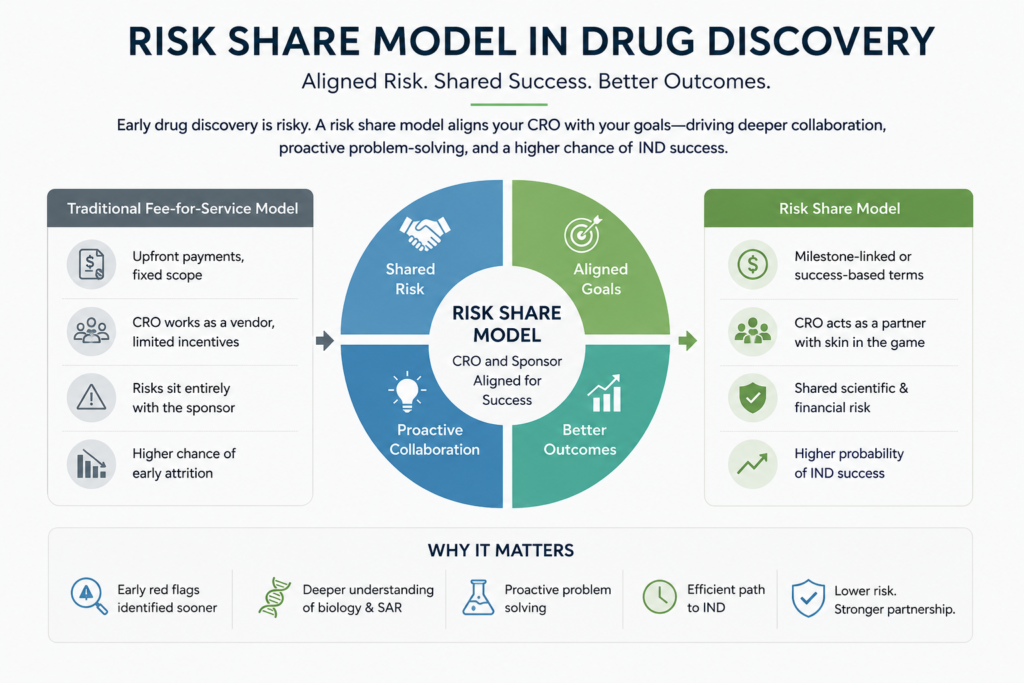
A risk share model is a partnership structure where a CRO (Contract Research Organization) takes on a portion of the scientific and financial risk alongside the sponsor.
Instead of a pure fee-for-service arrangement, both parties have skin in the game.
This can look like:
- Deferred payments tied to program milestones
- Equity or co-development arrangements
- Success-fee structures linked to IND filing or Phase I entry
- Reduced upfront costs in exchange for backend returns
The key idea is alignment. When a CRO benefits from your molecule’s success, they behave like a partner, not a vendor.
Why Early Discovery Is the Riskiest Stage
Most drug failures happen early. Poor pharmacokinetics, unexpected toxicity, and weak target engagement are the biggest culprits.
Research published in the Journal of Medicinal Chemistry (ACS Publications) identifies how outsourcing relationships in early R&D can sometimes limit scientific engagement. When CRO teams are kept isolated from structure-activity relationship (SAR) data, they may not flag problems that an integrated team would catch.
That is a structural risk built into the traditional fee-for-service model.
In contrast, deeply integrated CROs working under a risk share model are incentivized to:
- Flag early SAR red flags rather than just deliver compounds
- Invest in understanding the underlying biology
- Proactively solve synthesis problems instead of moving to the next compound
How to Identify CROs That Have Delivered IND Molecules
Not every CRO that talks about risk sharing can actually execute.
Here is what to look for when evaluating CRO partnerships for a risk share model arrangement:
1. Proven IND track record
Ask for the number of IND-enabling tox batches completed successfully. Look for documentation, not just claims.
2. Integrated discovery capabilities
The CRO should offer medicinal chemistry, biology, DMPK, and safety assessment under one roof. Handoffs between vendors multiply risk.
3. Process chemistry depth
Early synthesis quality determines everything downstream. A CRO with a strong process chemistry team will design more manufacturable molecules from the start.
4. Transparent communication culture
Risk-sharing partners ask hard questions. Find CROs whose scientific teams communicate freely about failures, not just successes.
5. Financial stability
A CRO entering a risk share must be stable enough to absorb deferred revenue. Ask about their balance sheet and existing portfolio of such arrangements.
What LAXAI Brings to the Risk Share Table
LAXAI Life Sciences is a Hyderabad-based CRDMO with over 17 years of experience in small molecule discovery and development.
LAXAI has delivered across more than 20 integrated discovery programs and 150+ CMC projects.
Their model is built for exactly this kind of partnership. They offer:
- End-to-end discovery services from target identification to IND filing
- In-house medicinal chemistry, biology, DMPK, and IND-enabling tox batches
- A team of 250+ scientists working across discovery, development, and manufacturing
- A track record with US biotech companies, including companies on the West Coast and firms like Berg Health and Angion Biomedica Corp
One client described LAXAI as their “extended R&D arm.” That is not the language you use for a vendor. That is the language you use for a partner.
Red Flags to Watch Out For
Not every CRO that claims to offer a risk share model actually delivers one.
Watch for these warning signs during early conversations:
- Vague milestone definitions that never trigger payment
- No history of IND molecule delivery under deferred terms
- Unwillingness to share SAR data or biological context with their chemistry team
- Heavy reliance on subcontractors for key steps, which dilutes accountability
The best risk share model arrangements are built on trust and scientific transparency. If a CRO is reluctant to have those conversations openly, that tells you something important.
The Bottom Line
The risk share model is not just a financial innovation. It is a scientific one.
When your CRO partner has real skin in the game, the quality of collaboration rises. Early warning signals get surfaced. Attrition goes down. And the path to IND becomes cleaner.
If you are evaluating CRO partners for your early discovery program, start with a simple question: Are they willing to share the risk?
At LAXAI, the answer is yes. And they have delivered IND molecules to back it up.
Explore LAXAI’s Integrated Drug Discovery services at laxai.com
FAQs
What is a risk-share model in drug discovery? A risk-share model is a CRO partnership structure where payment is tied to scientific milestones or program outcomes rather than a flat fee-for-service arrangement. It aligns the CRO’s incentives with the sponsor’s success.
Which CROs offer risk-share models? Only CROs with strong IND delivery track records, integrated capabilities, and financial stability can realistically offer risk-share arrangements. Integrated CRDMOs like LAXAI, which cover discovery through manufacturing, are better positioned than specialist-only vendors.
Does risk-sharing affect IP ownership? It can. Always clarify IP assignment terms before signing. Risk-share deals that include downstream royalties or co-development rights need explicit IP clauses to avoid disputes later.
At what stage is a risk-share model most valuable? Early discovery and lead optimization, before IND filing, are the highest-risk and highest-value points for a risk-share structure. Failures here are cheaper to absorb than failures in Phase I or Phase II.